1. What the Framework Is
The Capital Extraction Framework treats a stock position as a capital project, not a price bet.
We buy the company and immediately sell a long-dated covered call against that position.
This pulls future value into cash today through option premium.
The framework is now intentionally narrow. We are only doing capital extraction.
We are not mixing this with cash-secured puts or other side engines. That makes the framework easier to understand,
easier to audit, and easier to repeat.
Simple formula:
Locked Capital = Original Stock Cost − Net Premium Received
Day-1 / Whole-Cycle Profit = Net Premium Received + Assignment Value − Original Stock Cost
Return on Locked Capital = Profit ÷ Locked Capital
Break-Even / Downside Protection Price = Locked Capital ÷ Shares
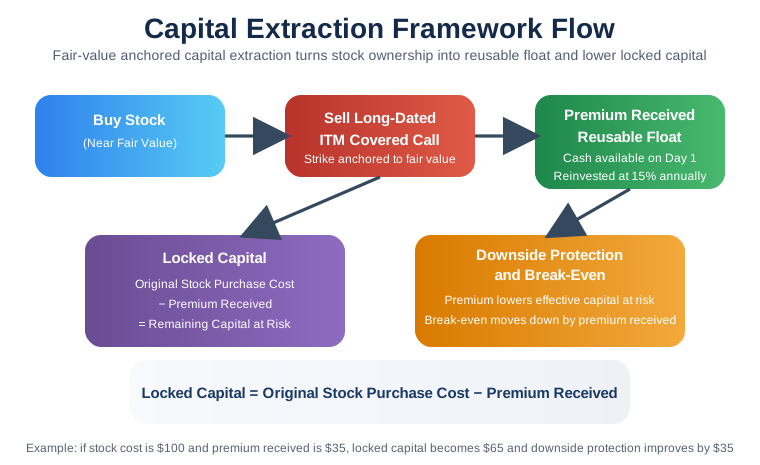
How Capital Extraction Works
The Capital Extraction framework begins by purchasing shares near fair value
and then selling a long-dated covered call anchored around fair value. The
premium received on Day 1 becomes reusable float and at the same time lowers
the capital still locked in the project.
This is the source of downside protection. Once premium is received, the
investor’s effective capital at risk is no longer the original purchase
cost. It becomes:
Locked Capital = Original Stock Purchase Cost − Premium Received
Premium extraction creates reusable float, reduces locked capital, improves
downside protection, and allows reusable float to be reinvested at 15% annually.
In practical terms, if a stock is purchased for $100 and $35 of premium is
extracted, only $65 remains locked in the project. That lower locked capital
becomes the new economic exposure, while the $35 premium serves as immediate
downside protection and reusable float for future reinvestment.
2. Why the Framework Exists
Traditional investing usually depends on one outcome: the stock price must rise. Capital Extraction changes that.
It seeks to create day-1 economic value by structuring the project near the company’s fair value.
When a project is created near fair value, the strike and the economics are aligned with the business itself,
not with market excitement. That often creates three immediate benefits:
- Day-1 profit: the premium can create positive economics at entry.
- Downside protection: premium reduces the capital truly at risk and lowers break-even.
- Reusable float: premium becomes real cash that can be redeployed elsewhere.
Core thesis: the framework works best when the stock is trading near fair value.
In those cases, the project does not need major future price appreciation to succeed.
It starts with profit quality, protection, and a defined return profile.
Important update: most new projects will now be anchored toward fair value. Occasional two-year structures
are still allowed for highly overvalued companies, but they are the exception, not the standard case.
3. Current Operating Rules
Primary anchorConservative fair value of the company.
Main instrumentLong-dated covered calls only.
Return requirement16% to 20% annualized on locked capital.
Preferred structureAnnualized return is preferred over longer contracts, often close to two years.
Capital baseReturns are measured on locked capital, not gross position value.
Reusable floatPremium received on day 1 is cash that can be reused elsewhere.
Whole-cycle lensWe also look at how reusable float and day-1 profit would compound if reinvested prudently.
Interpretation: a good CE project is not just one with high premium. It is one where fair value,
downside protection, reusable float, and annualized return all line up together.
4. Main Advantages of the Framework
- Fair-value discipline: prevents premium chasing and keeps strike selection tied to business value.
- Day-1 profit quality: many projects lock in economic value at entry.
- Lower effective capital at risk: premium lowers break-even immediately.
- Reusable float: extracted premium is real cash, not paper gain.
- Whole-cycle visibility: from day 1, the project already shows its expected total-cycle outcome if assigned.
- Parallel compounding potential: float and day-1 profit can be reinvested while the project runs.
- Better behavior under volatility: downside is engineered before the market tests the position.
Most important advantage: the framework is designed to turn market volatility into structured cash flow,
while keeping capital anchored to fair value instead of market narratives.
5. Three Examples
The examples below show how the framework behaves in three situations: near fair value,
far above fair value but still attractive because of rich premium, and fair-value anchoring with active reset.
To keep things clear, each block starts with the number of shares originally purchased.
Example 1 — CHWY: Near Fair Value, Clean CE Setup
Shares initially bought100 shares
Fair value$25.00
Trade date3/6/2026
Contract expiry1/15/2027 (0.86 years)
StructureSell 1 Jan 15, 2027 $25 covered call
Original purchase price$25.46 per share
Original stock cost$2,546.00
Capital extracted / reusable float$589.35
Assignment value$2,500.00
Locked capital$1,956.65
Break-even / downside protection price$19.57 per share
Whole-cycle project profit$543.35
Project return on locked capital27.77%
Project annualized return32.84%
Reusable float reinvestment gain @ 15%$75.55
Day-1 profit reinvestment gain @ 15%$69.65
Broad total gain for whole project$688.55
Broad total return on locked capital35.19%
Broad total annualized return41.82%
Framework interpretation: CHWY is the clearest expression of the framework. The stock was bought at about $25.46 and the strike was anchored at the $25 fair-value estimate. Because the project started very close to fair value, it did not need a large future rerating to work. The premium created day-1 profit immediately, reduced capital at risk, and established a strong annualized return from the start.
Why this example matters: This is the framework in its preferred form: fair-value anchored, high clarity, strong downside protection, and no dependence on speculation.
Downside protection meaning: after extraction, the project’s break-even falls to $19.57 per share.
That is the price level where the project roughly breaks even economically. This shows why extraction matters:
it lowers effective exposure from the original purchase price and creates a wider survival range.
Example 2 — ALAB: Overvalued, but Very Strong Protection and Yield
Shares initially bought200 shares
Fair value$80.00
Trade date2/12/2026
Contract expiry1/21/2028 (1.94 years)
StructureSell 2 Jan 21, 2028 $80 covered calls
Original purchase price$145.97 per share
Original stock cost$29,195.00
Capital extracted / reusable float$18,298.70
Assignment value$16,000.00
Locked capital$10,896.30
Break-even / downside protection price$54.48 per share
Whole-cycle project profit$5,103.70
Project return on locked capital46.84%
Project annualized return21.90%
Reusable float reinvestment gain @ 15%$5,698.33
Day-1 profit reinvestment gain @ 15%$1,589.32
Broad total gain for whole project$12,391.35
Broad total return on locked capital113.72%
Broad total annualized return47.93%
Framework interpretation: ALAB was far above fair value, so it is not the ideal near-fair-value case. But the premium was exceptionally rich. That large extraction sharply lowered the effective capital exposed to the project and still produced an attractive annualized return. This is the framework’s defensive use case for a highly overvalued company that may need more time to move back toward fair value.
Why this example matters: ALAB shows that a two-year project can still work when fair value is far below market price, provided the extraction is large enough to create both protection and yield.
Downside protection meaning: after extraction, the project’s break-even falls to $54.48 per share.
That is the price level where the project roughly breaks even economically. This shows why extraction matters:
it lowers effective exposure from the original purchase price and creates a wider survival range.
Example 3 — ORCL: Fair Value Anchor with Active Reset
Shares initially bought100 shares
Fair value$190.00
Trade date10/15/2025
Contract expiry1/21/2028 (2.27 years)
StructureSell 1 Jan 21, 2028 $190 covered call, then reset as price reverted toward fair value
Original purchase price$305.46 per share
Original stock cost$30,545.50
Capital extracted / reusable float$14,470.35
Assignment value$19,000.00
Locked capital$16,075.15
Break-even / downside protection price$160.75 per share
Whole-cycle project profit$2,924.85
Project return on locked capital18.19%
Project annualized return7.65%
Reusable float reinvestment gain @ 15%$5,398.45
Day-1 profit reinvestment gain @ 15%$1,091.17
Broad total gain for whole project$9,414.47
Broad total return on locked capital58.57%
Broad total annualized return22.53%
Framework interpretation: ORCL started with the stock far above the $190 fair-value anchor. The original project was written at the fair-value strike, and then the stock fell to about $190 within roughly three months. That allowed the project to be reset: the first $190 call was bought back, a $250 call was sold, later that $250 call was bought back, and a new $190 call was sold again. The result shows how fair-value anchoring can protect economics and support additional premium extraction when mean reversion happens early.
Why this example matters: ORCL is mainly a framework-mechanics example. It shows that fair value matters more than market price, and that resets can improve capital extraction when valuation normalizes quickly.
Downside protection meaning: after extraction, the project’s break-even falls to $160.75 per share.
That is the price level where the project roughly breaks even economically. This shows why extraction matters:
it lowers effective exposure from the original purchase price and creates a wider survival range.
6. Whole-Cycle Summary of the Three Examples
| Project |
Shares |
Break-Even |
Locked Capital |
Project Profit |
Float Gain @ 15% |
Day-1 Gain @ 15% |
Broad Total Gain |
Broad Return |
| CHWY |
100 |
$19.57 |
$1,956.65 |
$543.35 |
$75.55 |
$69.65 |
$688.55 |
35.19% |
| ALAB |
200 |
$54.48 |
$10,896.30 |
$5,103.70 |
$5,698.33 |
$1,589.32 |
$12,391.35 |
113.72% |
| ORCL |
100 |
$160.75 |
$16,075.15 |
$2,924.85 |
$5,398.45 |
$1,091.17 |
$9,414.47 |
58.57% |
| Total |
400 |
— |
$28,928.10 |
$8,571.90 |
$11,172.33 |
$2,750.15 |
$22,494.38 |
77.76% |
Main takeaway: CHWY shows the strongest pure framework form because it was built near fair value.
ALAB shows that a far-overvalued stock can still produce strong economics when premium is large enough.
ORCL shows the importance of anchoring to fair value first and then managing the project actively when mean reversion happens early.
Broad total return lens: the broad gain numbers above add three pieces together —
whole-cycle project profit, reusable float reinvestment gain at an illustrative 15% annual rate,
and day-1 profit reinvestment gain at the same rate. This is not a guaranteed return.
It is a practical way to show the framework’s parallel compounding potential.
7. Conclusion
The simplified Capital Extraction Framework is now a fair-value anchored covered-call system.
It exists to create day-1 profit, reduce downside through premium extraction, and produce reusable float.
It does not rely on constant market appreciation, and it no longer depends on side strategies.
The framework’s preferred use is straightforward: build projects near fair value, measure return on locked capital,
require roughly 16% to 20% annualized return whenever possible, and respect downside protection as a first-class objective.
Two-year projects are still appropriate in selected cases when a strong company is trading far above fair value and needs more time to normalize.
Final thesis: anchor the strike to fair value, extract cash on day 1, lower the break-even, protect the downside, and let reusable float improve the economics of the whole cycle.
Disclaimer: Educational illustration only; not investment advice. Options involve risk, including the potential loss of principal.
Fair-value estimates are judgment-based and must be applied conservatively. Reinvestment gains at 15% are illustrative assumptions used to explain parallel compounding.