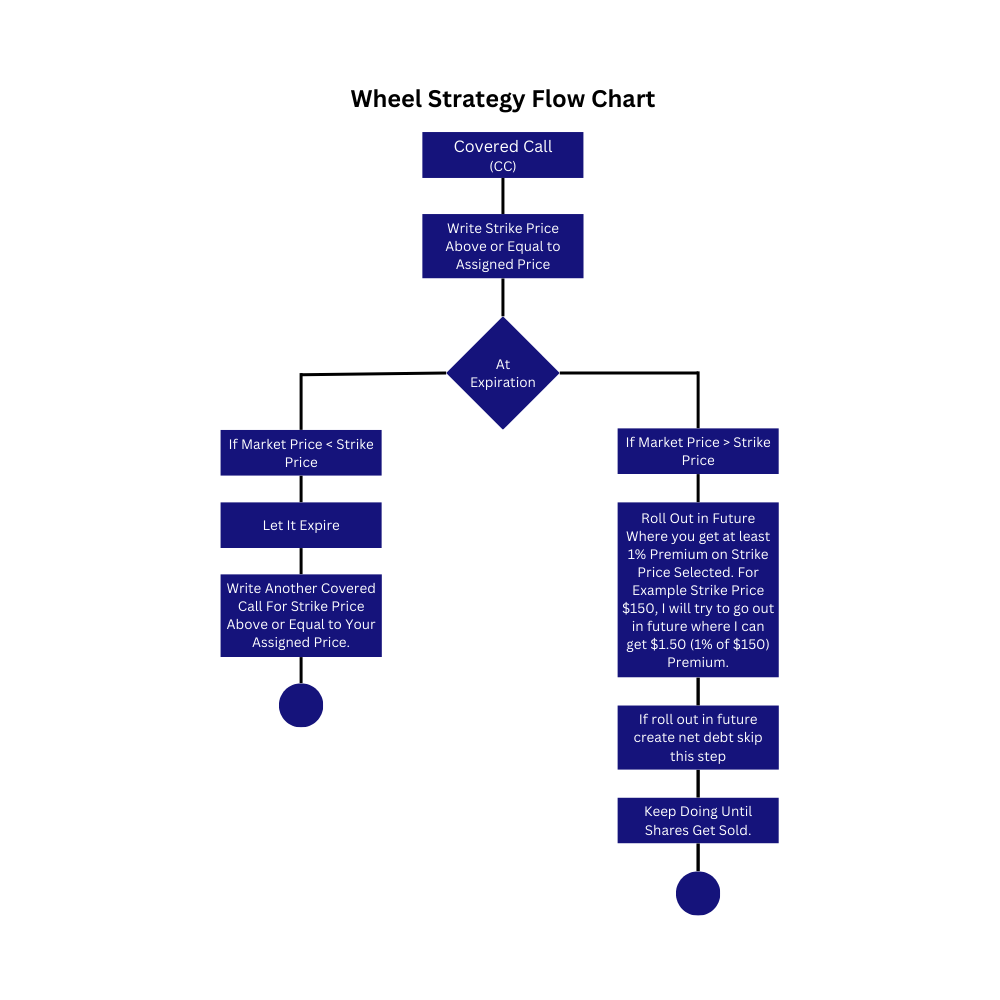
Sole Strategy: I exclusively utilize the Wheel Strategy for all trades.
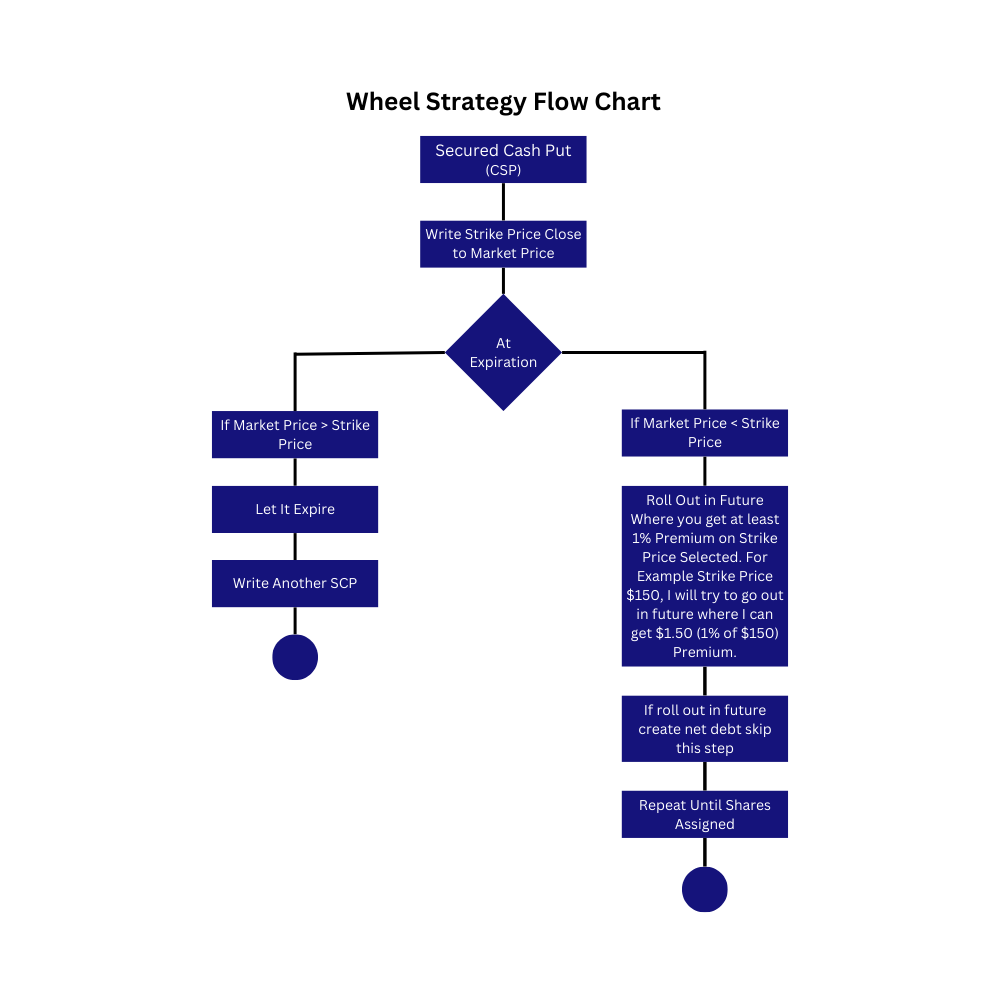
Trade Transparency: All trades executed within my portfolio are shared with the group. Comments marked "// recommendation" indicate trades I believe are beneficial but haven't personally executed, explaining the rationale behind them.
Premium Income Distribution: My premium income strategy is structured into three distinct segments:
Core Portfolio (80%)
This segment generates the majority of premium income.
Allocate 2-5% of your total portfolio value to each core position.
Diversification is crucial. Avoid overconcentration in just a few positions (e.g., two positions representing 50% each).
High-Premium, Non-Core Companies (15%)
This segment includes companies that offer substantial premiums but aren't suitable for the core portfolio due to various factors.
Examples include TSLA, CMG, MSTR, AMD, CHWY, UBER, and PLTR.
These are strong companies, but their long-term stability is less certain, hence their exclusion from the core.
Crucially, limit investment in these companies to a maximum of 1% of your total portfolio value.
Earnings Plays (5%)
This segment capitalizes on the significantly increased premiums during earnings weeks.
Limit investment in these trades to 0.5% of for each company and altogether don't exceed 5% cost of your total portfolio value.
How to Select Premium?
Cash Secured PUT
If the company is undervalued or fairly valued, I write at market price to squeeze maximum premium.
If it is slightly overvalued or close to fair value, then as a defensive play:
Select a strike price that gives me 2% monthly premium. Example: If you select a $150 strike price, it should give you at least $3 or less premium.
If the company is quite overvalued and shoots up in price in only a few trading sessions, I aim for a 1% monthly premium and select the price accordingly.
Covered Call
I mainly write calls at or above my assigned or purchase price. Never write covered calls below your assigned price.
If the stock is far down from my assigned or purchase price, then I go out two to three months to get a premium amount that equates to 1% of the assigned price.
Example: If my assigned price is $100 and the stock is currently trading at $75, I will go out in the future with a strike price (same as assigned price) that gives me a $1 (1% of $100) premium.
Advertisement
Advertisement
Advertisement
Advertisement
Advertisement
Sign Up free to view live trades and discussion forum to make more informed financial decisions. No credit card is required for sign up! View Daily Trades Join Discussion
Advertisement
Advertisement
Advertisement
Advertisement
Disclaimer
The Value-Trades website is intended for informational purposes only. The
content provided on this website, including but not limited to recommendations, analysis, and
opinions, should not be considered financial advice.
Before making any investment decisions, whether buying or selling, based on information obtained
from this website, it is imperative that you conduct your own thorough due diligence. This
includes consulting with a qualified financial advisor, reviewing financial statements, and
understanding the risks involved in any investment.
The owner of this website shall not be held responsible for any financial losses incurred as a
result of using the information provided herein. Investing in financial markets involves risk,
and past performance is not indicative of future results. You are solely responsible for your
investment decisions.
Terms & Conditions
By using our services, you agree to our
Terms & Conditions
.
Please review them carefully.